After a long day of sightseeing on the last day of our trip, we decided to take the Underground to the hotel.
Our hotel was conveniently located in Terminal 2 at the airport, so taking the train seemed like the easiest option.
What we hadn't thought through was the luggage.
We were navigating heavy suitcases through the Underground, not expecting to encounter the lack of elevators—or lifts, as they're called in London.
And just before we reached our platform, we discovered that the two-story escalator was out of service.
I started clanking my suitcase down the stairs, one step at a time.
I tried turning it sideways to make it easier, but I could see the people behind me starting to back up.
I could also feel the growing annoyance of my traveling partner.
A few people back, someone finally came to my rescue and carried my suitcase down the rest of the stairs.
I was incredibly grateful.
We made the train.
We arrived at the airport.
And surely, things would get easier from there.
They didn't.
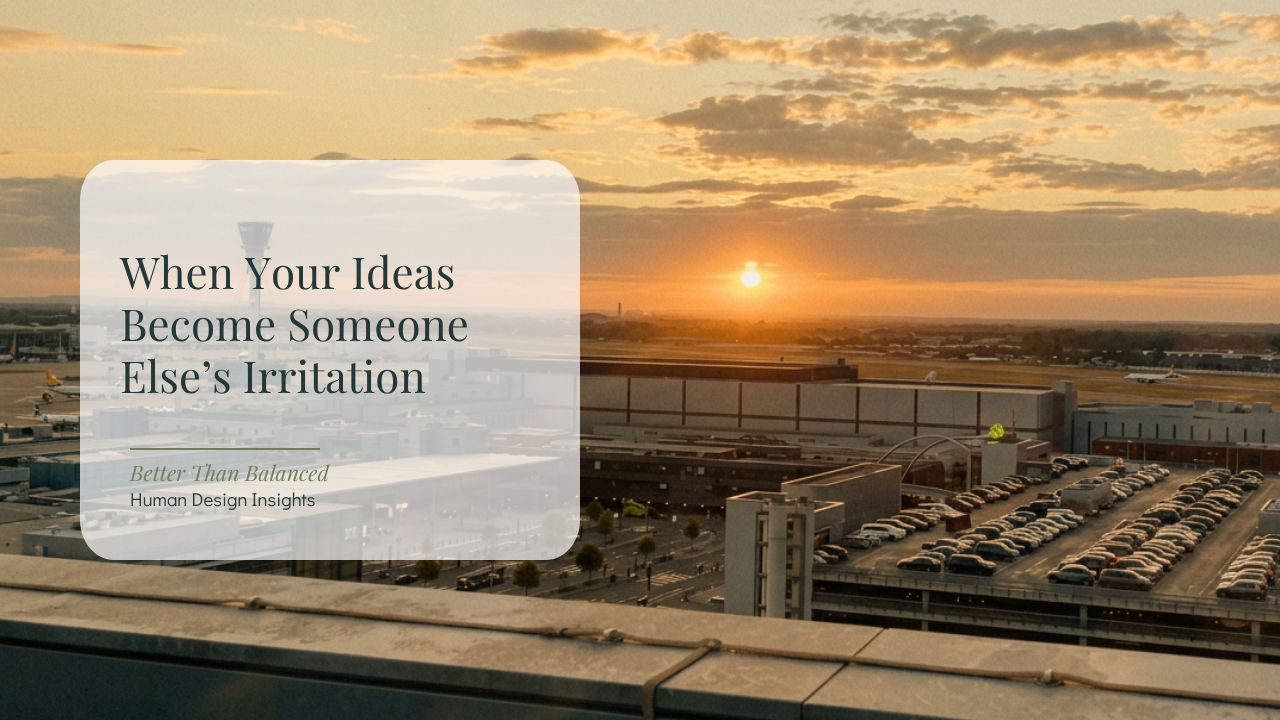
We hauled our luggage into the hotel room, tired and ready for dinner. We decided to go to the rooftop restaurant where we could eat and watch the activity at the airport.
We walked to the elevators.
There was one on the left and one on the right.
I pushed the button.
We got into the elevator on the right.
No rooftop button.
So we got out.
I said, "Maybe the other elevator has the rooftop button."
That suggestion was immediately shot down.
So we went to the front desk to ask.
The answer?
"Your room key will take you to the roof."
Back to the elevators we went.
I said, "Let's just try the other one."
Sure enough, it had the rooftop button.
Up we went.
And I couldn't help but think:
This is what Compromise can feel like.
I already knew that this particular connection had a Compromise in what is called Curiosity, A Design of a Searcher (Ideas and Stimulation).
I carry the complete energetic channel.
They carry only one of the gates, Ideas.
In Human Design, this creates a Compromise dynamic.
One person naturally carries the full expression of the energy, while the other experiences only part of it.
And in our connection, I began to notice something.
My ideas could be irritating to them.
It wasn't that I was trying to be difficult.
And they weren't trying to be difficult either.
But when our energies came together, my natural tendency to offer ideas could create friction.
Before I understood Human Design, I took this personally.
I wondered why my suggestions seemed to be so irritating.
Why did something that seemed completely reasonable to me create such a reaction?
I thought there was something wrong with the way I was communicating.
Or maybe something was wrong with them.
I didn't understand what was happening beneath the surface.
Then I learned about Compromise.
And something shifted.
I realized that the irritation wasn't necessarily about me.
And it wasn't necessarily about them.
It was about what happened when our two energies came together.
That's an important distinction.
Because when we don't understand the mechanics of a connection, it's easy to make everything personal.
Why are they always doing that?
Why can't they just listen?
Why does everything I say seem to bother them?
Why do we keep having the same issue?
We can spend a tremendous amount of energy trying to fix the other person—or ourselves.
But what if nothing has gone wrong?
What if you're simply experiencing a dynamic that is built into the connection?
Awareness changes the way you meet the connection.
Once I understood our Compromise, I didn't need the other person to become different.
I didn't need them to respond to my ideas the way I thought they should.
And I didn't need to stop being myself.
I could simply become aware of what was happening.
That awareness gave me another choice.
Instead of turning the interaction into a tug-of-war, I could step back and observe the energy.
I could allow the other person to be who they are.
And I could allow myself to be who I am.
The Compromise didn't disappear. My relationship to it changed.
That may be one of the most valuable things Human Design has taught me about relationships.
Not every difficult dynamic needs to be fixed.
Some need to be understood.
Some need to be accepted.
And sometimes, when you understand what's happening, you can stop taking it personally.
You can stop fighting against the energy.
You can step back into your own Strategy and Authority and allow the other person to do the same.
That doesn't mean every relationship will work.
It doesn't mean you have to tolerate behavior that isn't correct for you.
It simply means you can begin seeing the connection more clearly—without automatically assigning blame.
Two people can be completely themselves and still create a dynamic that feels challenging when they come together.
That's not failure.
That's awareness.
And awareness creates space for something different: more compassion, less blame, and a greater ability to meet each other as the people you actually are.
If you've ever wondered why the same frustration seems to surface again and again with someone in your life, there may be something happening in the mechanics of your connection that you haven't seen yet.
You can start exploring that connection for free.
Get your 👉Free Human Design Connection Chart and begin discovering what happens when your unique design meets someone else's. You'll also get my free guide, The Hidden Pattern Behind Recurring Relationship Frustrations to help understand Compromises better.
Thanks for being here.
— Leslie
Human Design Analyst